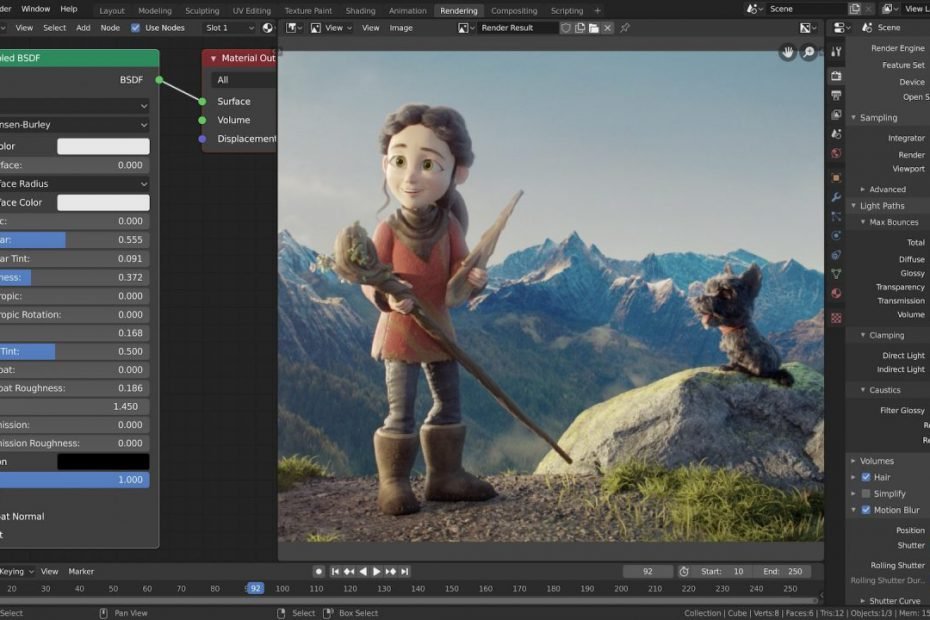

Blender was created by Ton Roosendaal, a Dutch art director and self-taught software developer. Attracted to all things technical and creative, Roosendaal began a degree in Industrial Design, but dropped out in order to start his own 3D animation studio, NeoGeo, in 1989 (the video game console of the same name appeared a year later). Initially based in Roosendaal’s attic, NeoGeo grew rapidly, garnering awards and becoming the biggest company of its type in the Netherlands.
Roosendaal wrote the first source files titled “Blender” on the 2nd of January, 1994, still considered Blender’s official birthday. Originally, Blender was planned as an in-house application for NeoGeo; it grew from a series of pre-existing tools, including a ray-tracer built for the Amiga. This early version of Blender was intended to address a perennial frustration among creatives: when a difficult client requires multiple changes to a project, how do you implement those changes painlessly? Thanks to its highly configurable approach, Blender aimed at providing an answer. (As an aside: the name refers to a song by a Swiss electronic band, Yello).
Roosendaal invested his savings in a Silicon Graphics workstation. Costing the equivalent of thirty thousand US dollars, this computer led to Blender 1.0. Launched in January 1995, this first iteration of Blender proper incorporated then innovative ideas, including a single window which could be subdivided as the user saw fit.
At the time, 3D was considered commercially uninteresting. However, Roosendaal had fallen in love with what he describes as its “magical ability to create a whole world in a computer.” So when NeoGeo closed, he and partner Frank van Beek founded a new company focused on further developing and marketing Blender. Not a Number (NaN) opened its doors in June 1998, distributing Blender under a freemium pricing strategy: the software was free to download, with NaN selling keys to unlock more.